Internal Developer Platform for
SaaS teams

Cloud-native Internal Developer Platform (IDP) that provisions and manages production-grade Kubernetes environments on your AWS account. With CI/CD, observability, and security hardening included.

No Dockerfiles. No Helm charts. No Terraform.

Trusted by developers at leading companies

Used by developers at

What problems does an internal developer platform solve for SaaS teams?

Challenges Growing Engineering Teams Face

Engineers waiting on DevOps

Every change in infrastructure waits in a queue, for the cloud operations team to provision and configure. Takes weeks to ship every single feature.

Environment drift

Inconsistent configuration across environments, VPCs, and IAM roles. Security groups. Staging passes. Production breaks. Incidents that are slow to debug and nearly impossible to prevent with scripts alone.

Blind spots in production

Without a pre-configured observability stack, monitoring is always a backlog item. Until there's an incident and your team has no logs, no metrics, and no time.

This is exactly what LocalOps is built for, by a team that's done cloud infrastructure and Kubernetes deployments for SaaS companies firsthand. LocalOps is an Internal Developer Platform that automates environment provisioning and deployment automation on your AWS account. Observability, CI/CD, and security hardening configured from day one so your engineers stop managing infrastructure and start shipping product.

How It Works

From signup to a production-grade AWS environment in 30 minutes.
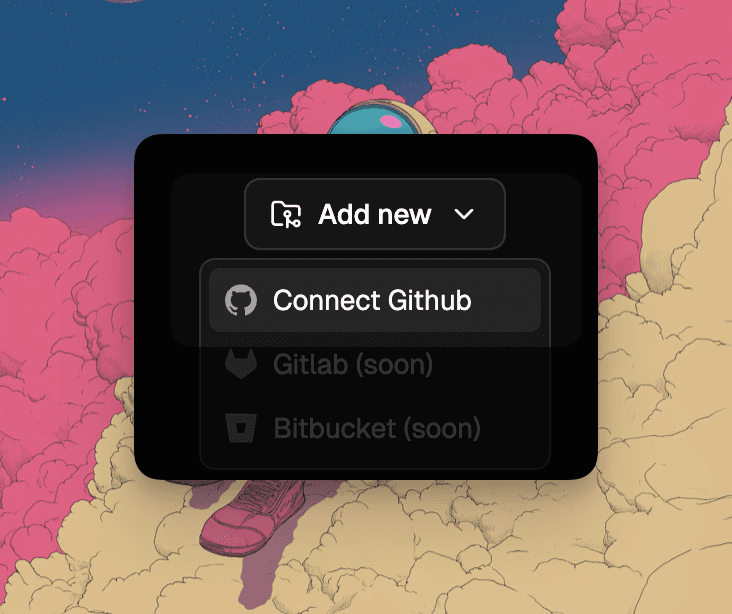
Connect your GitHub repo

Link your GitHub account and repos. LocalOps hooks into your configured branches and triggers automated builds on every push.
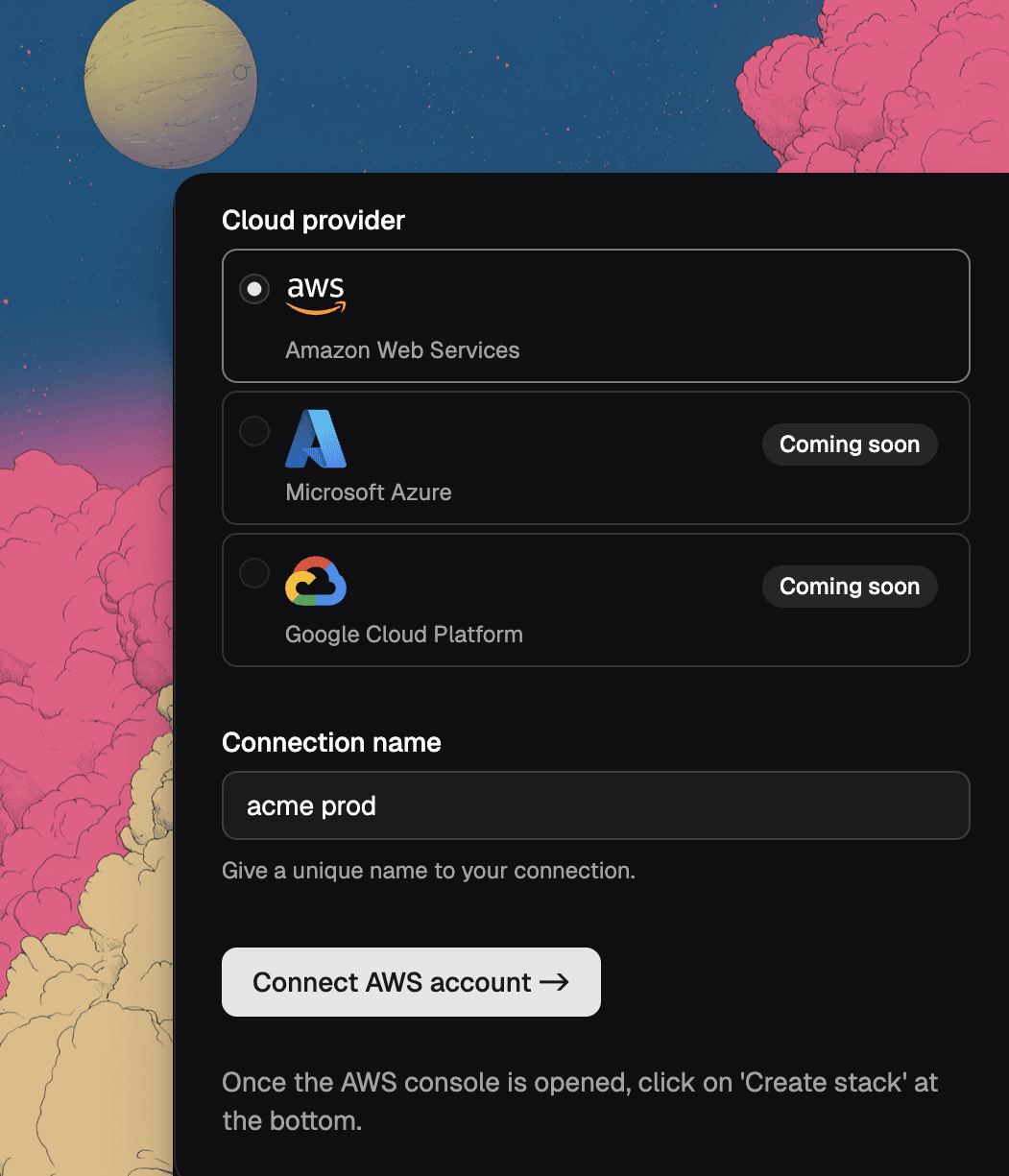
Connect your AWS account

Keyless, role-based IAM access. LocalOps assumes a role in your AWS account to provision resources. Your credentials never leave your cloud.
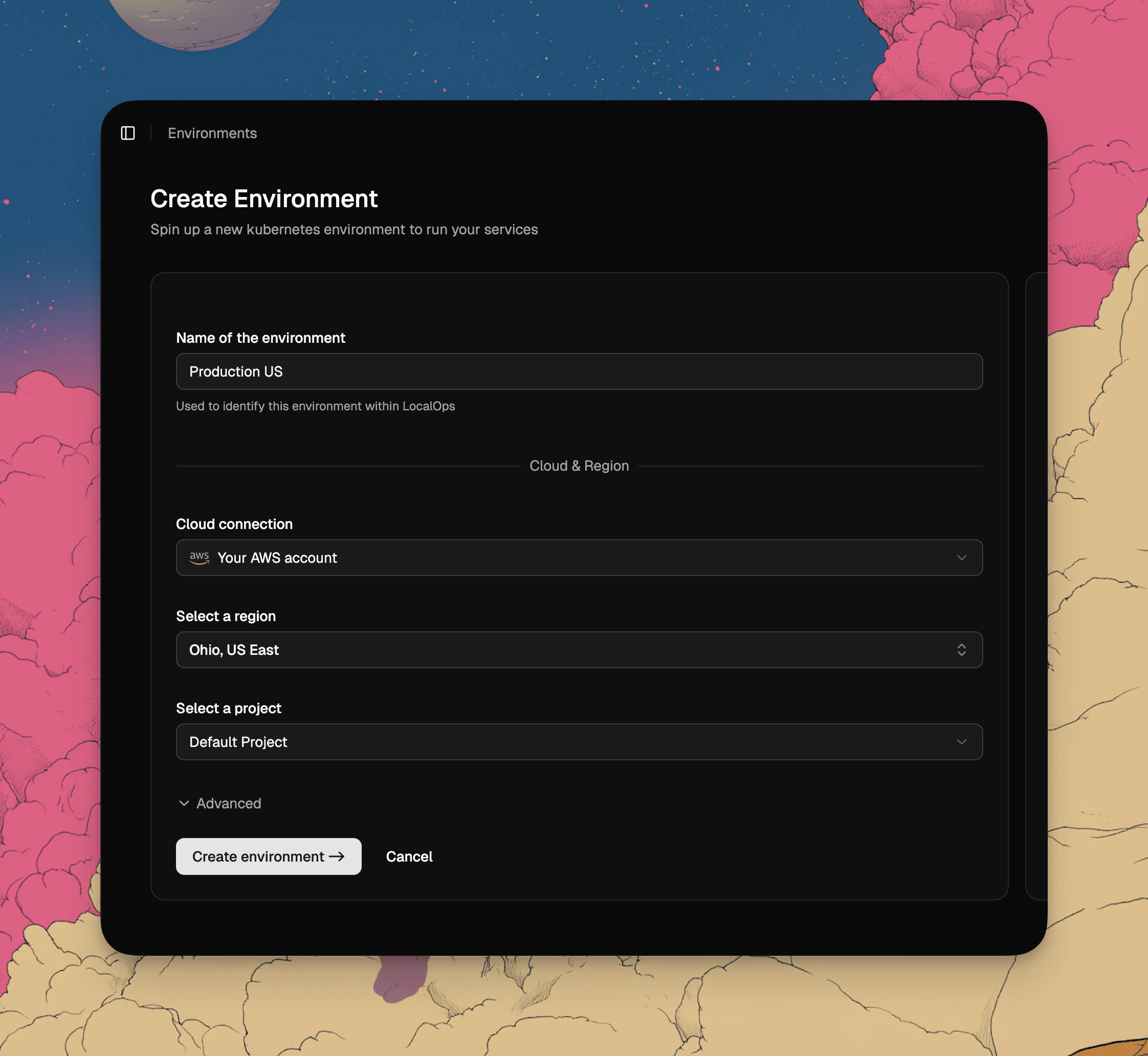
Deploy services

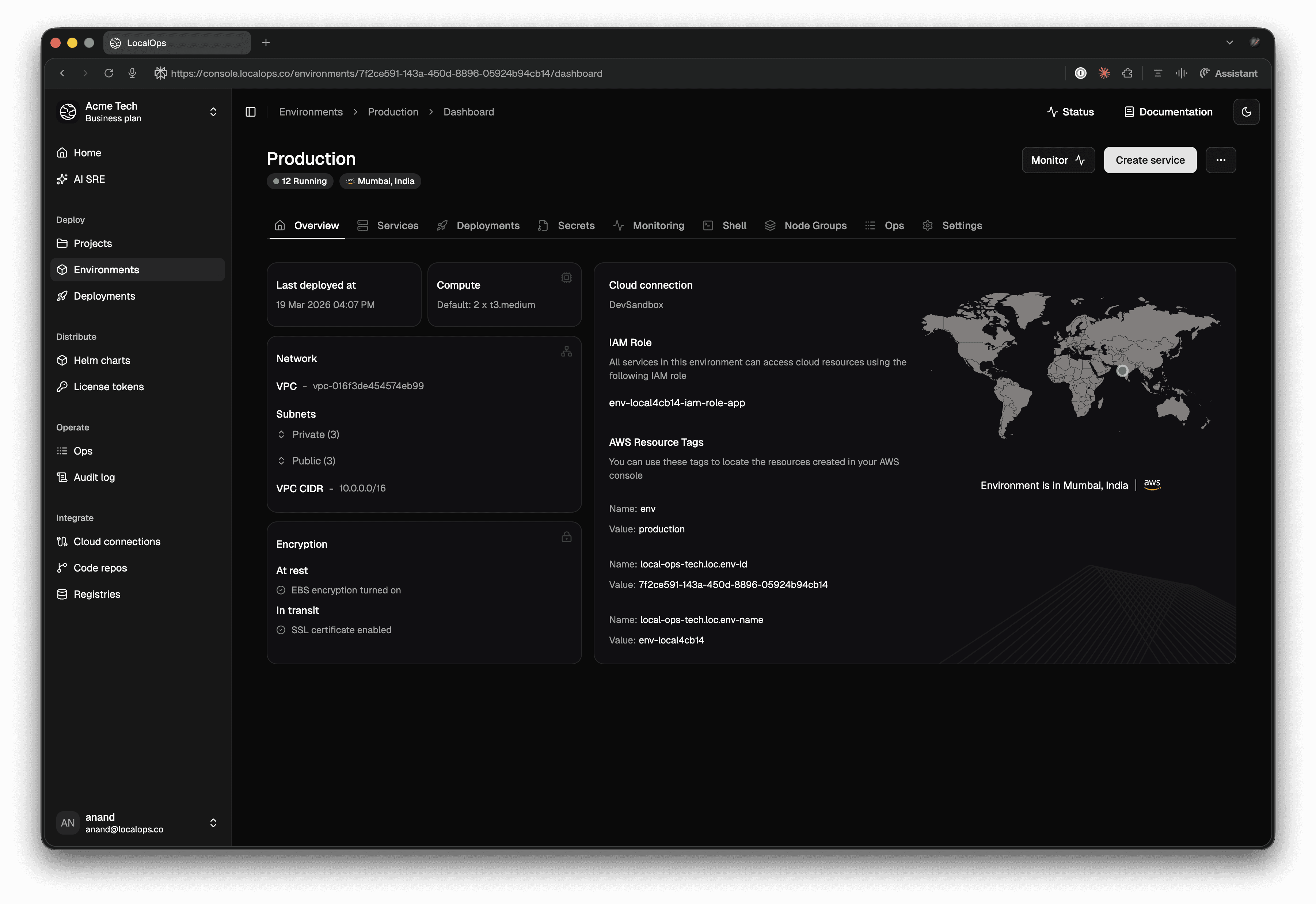
LocalOps provisions a dedicated VPC, subnets, and EKS cluster for each environment. Loki, Prometheus, Grafana, and CI/CD wired in automatically. Push to your linked branch your IDP handles the rest. Build, deploy, observability, all self-serve from day one.

What you get with LocalOps

Isolated infrastructure per environment

Every environment gets its own dedicated VPC, private and public subnets, and EKS cluster. Blast radius is contained. Teams can experiment without risking shared production infra.

Auto healing and Auto scaling

Services run on a managed EKS cluster with auto-healing and horizontal scaling built in. Your applications stay available through failures and traffic spikes without manual intervention

Automated CI/CD pipeline

LocalOps connects to your GitHub repos and handles deployment automation on every push to configured branches. No custom pipelines to configure or maintain.

Preview environments

Preview changes of each pull request in its own url. Test them in isolation and release. Stop asking developers to wait for their turn on your shared QA environment.

Built-in observability

Loki, Prometheus, and Grafana pre-installed and wired together in every environment. Logs and metrics available from day one, not set up reactively when something breaks.

Security best practices by default

Environments are provisioned with AWS security best practices out of the box. Network isolation, role based access, encrypted storage, hardened defaults. Built to AWS security standards from day one.

Isolated infrastructure per environment

Every environment gets its own dedicated VPC, private and public subnets, and EKS cluster. Blast radius is contained. Teams can experiment without risking shared production infra.

Automated CI/CD pipeline

LocalOps connects to your GitHub repos and handles deployment automation on every push to configured branches. No custom pipelines to configure or maintain.

Built-in observability

Loki, Prometheus, and Grafana pre-installed and wired together in every environment. Logs and metrics available from day one, not set up reactively when something breaks.

Auto healing and Auto scaling

Services run on a managed EKS cluster with auto-healing and horizontal scaling built in. Your applications stay available through failures and traffic spikes without manual intervention

Preview environments

Preview changes of each pull request in its own url. Test them in isolation and release. Stop asking developers to wait for their turn on your shared QA environment.

Security best practices by default

Environments are provisioned with AWS security best practices out of the box. Network isolation, role based access, encrypted storage, hardened defaults. Built to AWS security standards from day one.

Isolated infrastructure per environment

Every environment gets its own dedicated VPC, private and public subnets, and EKS cluster. Blast radius is contained. Teams can experiment without risking shared production infra.

Built-in observability

Loki, Prometheus, and Grafana pre-installed and wired together in every environment. Logs and metrics available from day one, not set up reactively when something breaks.

Preview environments

Preview changes of each pull request in its own url. Test them in isolation and release. Stop asking developers to wait for their turn on your shared QA environment.

Automated CI/CD pipeline

LocalOps connects to your GitHub repos and handles deployment automation on every push to configured branches. No custom pipelines to configure or maintain.

Auto healing and Auto scaling

Services run on a managed EKS cluster with auto-healing and horizontal scaling built in. Your applications stay available through failures and traffic spikes without manual intervention

Security best practices by default

Environments are provisioned with AWS security best practices out of the box. Network isolation, role based access, encrypted storage, hardened defaults. Built to AWS security standards from day one.

You Own the Infra. We Handle the Ops.

You own

Infrastructure and data

Your code

Your AWS account

Your data

Your cloud bill

LocalOps IDP handles

DevOps automation

Environment provisioning

Kubernetes setup and management

CI/CD configuration and deployment automation

Observability stack (Loki, Prometheus, Grafana)

Security hardening and compliance defaults

Upgrades

No vendor lock-in: Your cloud infrastructure runs in your AWS account. Every resource LocalOps provisions stays fully accessible to your team and under your control.

Why LocalOps IDP

10-12

Man months saved
vs building your IDP in-house

30 min

Environment setup
vs months of manual Terraform

3x

Deployment frequency
DORA elite performance

Up to 50%

Savings in infrastructure costs
via auto-scaling

Build vs Buy

Compare time, effort and operational complexity

DIY

Build yourself

Manual VPC, EKS, subnets, EC2 via Terraform. Weeks of setup.

Custom Dockerfile and Helm charts. Manual GitHub Actions setup.

Separate Loki, Prometheus, and Grafana install and config per environment.

Manual auto-scaling configuration.

Manual encryption and security group configuration.

10 to 12 man months of tooling and setup.

10-12 man months

10-12 man months

Buy

LocalOps IDP

Auto-provisions VPC, EKS cluster, subnets, NAT gateway, and compute nodes in under 30 minutes.

Connect GitHub repo. Push to branch. LocalOps builds and deploys automatically. No Dockerfile or Helm required.

Loki, Prometheus, and Grafana pre-installed and wired into a single Grafana dashboard in every environment.

Built-in auto-scaling and self-healing out of the box.

Encryption in transit and at rest, security groups enabled by default on every environment.

30 minutes per environment. Full stack from day one.

Get started in 30 minutes

Get started in 30 minutes

Every hour your team spends on cloud infrastructure provisioning is an hour of business value not shipped to production. LocalOps is one of the best platforms for internal developer experience, handling the infrastructure layer so your engineering capacity stays on the product.

Why LocalOps Is One of the Best Internal Developer Platforms for SaaS Teams

Here’s What CTOs Say

"Their thoughtfully designed product and tooling entirely eliminated the typical implementation headaches. Partnering with LocalOps has been one of our best technical decisions."

— Prashanth YV, Ex-Razorpay, CTO and Co-founder, Zivy

"They are experts in Cloud deployments and Kubernetes. We saved months of DevOps effort by using LocalOps."


— Shobit Gupta, Ex-Uber, CTO and Co-founder, Segwise

Your Internal developer platform shouldn’t take 12-18 months to build.

Your Internal developer platform shouldn’t take 12-18 months to build.

Your internal platform, ready in minutes not months.

Your internal platform, ready in minutes not months.

Runs in your AWS account. No lock-in.

//

FAQs

Questions? We've got answers.

What is an IDP and why does your engineering team need one?

Do I need to hire a DevOps engineer to use LocalOps?

Do I need to write any automation scripts using Terraform?

Does LocalOps have access to my code?

If LocalOps goes down, will my apps go down?

Can I exit LocalOps at any time?

LocalOps IDP vs Backstage vs Terraform: what's the difference?

How is LocalOps different from an internal developer platform open source solution?

How long does it take to build an internal developer platform on AWS?

Internal developer portal vs platform: what is the difference?

How does an internal developer platform enable a platform engineering strategy?

Do you need a platform engineering team to use LocalOps?

Read more

Suggested Articles

What Is an Internal Developer Platform (IDP)?

Understand what an IDP is, its core components, and how teams use it to improve developer productivity

Cost of Building an IDP: In-House vs Buy

Compare the time, effort, and operational overhead of building an IDP in-house versus adopting a platform

Standardize Dev, Staging and Production Environments with an IDP

Learn how to standardize environments to reduce inconsistencies and improve reliability across deployments